
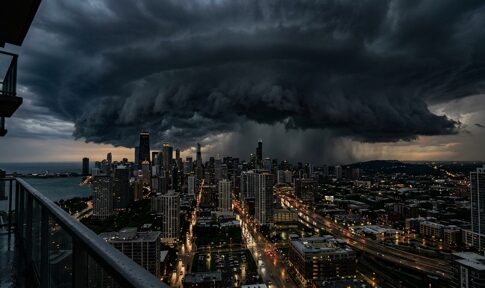
Tehran’s skies turned black and rain became a toxic weapon when US-Israeli airstrikes on oil depots triggered an environmental catastrophe that experts warn could cause heart attacks, cancer, and premature death for millions.
When the Sky Becomes a Weapon
The morning of March 8, 2026 arrived without sunrise for Tehran’s residents. Thick black smoke from burning oil depots blotted out the sun, turning day into an eerie twilight. When rain began falling, it carried an oily sheen and left dark residue on every surface it touched. The Iranian Red Crescent measured the precipitation’s acidity at pH 4.0, significantly more acidic than normal rain’s 5.6 and crossing the threshold into dangerous territory. Citizens who ventured outside reported immediate burning sensations on exposed skin.
The strikes had targeted approximately 30 fuel storage facilities across Tehran, including the Shahran depot. Israeli Defense Forces claimed these sites supported military fuel transfers, justifying the operation as counter-terrorism. The United States received advance notice but later acknowledged the operation’s scale exceeded expectations, marking a rare public acknowledgment of friction within the US-Israel alliance. The fires burned for days, continuously pumping pollutants into the atmosphere where storm systems mixed them with moisture to create what scientists classify as a major environmental incident.
The Science Behind Black Rain’s Deadly Toll
Charles Driscoll from Syracuse University explained that producing visible black rain requires extremely high concentrations of pollutants in the atmosphere. The combustion of petroleum products releases a toxic cocktail: hydrocarbons that coat surfaces, sulfur oxides and nitrogen oxides that create acidity, heavy metals that accumulate in tissue, and fine particulate matter small enough to penetrate deep into lungs and enter the bloodstream. These microscopic particles pose the greatest long-term threat, traveling through the body to damage hearts, brains, and developing fetuses.
The Conflict and Environment Observatory designated the incident a major environmental event caused by armed conflict. Unlike typical industrial acid rain that develops gradually from pollution, this black rain resulted from concentrated wartime destruction of energy infrastructure. Historical parallels exist with Hiroshima and Nagasaki’s radioactive black rain and Chernobyl’s contaminated precipitation, but those involved nuclear disasters rather than conventional weapons targeting fossil fuel reserves. The distinction matters little to those breathing the toxic air or washing acidic residue from their children’s skin.
Immediate Health Crisis and Long-Term Consequences
Tehran’s hospitals reported surges in patients experiencing respiratory distress, severe headaches, eye irritation, and chemical burns. Authorities issued advisories for all residents to remain indoors, but masks grew scarce and many workers had no choice but to brave the toxic conditions. Pregnant women faced particular concern as fine particles cross placental barriers, threatening fetal development. The World Health Organization verified attacks on 13 health facilities since hostilities escalated, killing first responders and disrupting $26 million in essential aid shipments.
The long-term health implications extend far beyond the immediate crisis. Fine particulate matter that enters the bloodstream increases risks of heart attacks and strokes by inflaming cardiovascular tissue and promoting blood clots. Carcinogenic compounds in the black rain raise cancer rates across exposed populations. Children face developmental challenges as toxins interfere with normal growth. Iran’s Foreign Minister Seyed Abbas Araghchi warned that soil and groundwater contamination would persist for years, creating cascading public health problems. The UN’s Ravina Shamdasani questioned whether strikes on non-exclusively military targets met proportionality standards under international law.
Regional Escalation and Energy Security Threats
Iran vowed revenge for the attacks, threatening to activate dormant capabilities throughout the Gulf region. Iranian drones had already struck ports in Oman at Salalah and Duqm, demonstrating reach beyond the Strait of Hormuz and endangering global energy exports. The Israeli Defense Forces pledged to act forcefully against any retaliation, setting the stage for potential wider conflict. Regional governments watched nervously as the world’s most critical oil transit corridors faced unprecedented instability.
The environmental warfare dimension represents a troubling evolution in Middle Eastern conflict. Targeting energy infrastructure creates military effects while inflicting massive civilian harm through environmental contamination. UNICEF documented 180 child deaths since the conflict escalated, including casualties from a school strike. The black rain phenomenon illustrates how modern warfare’s effects extend far beyond battlefields and combatants. Ten million Tehran residents became casualties not from explosions but from breathing air weaponized by burning petroleum. The question of whether such tactics constitute war crimes or acceptable military necessity divides international observers along predictable lines, with critics noting the disproportionate civilian suffering.
Sources:
When war falls as black rain in Iran’s Tehran – CGTN
UN warns of black rain after Israel and US strikes in Iran – JURIST
Black rain fell in Iran after strikes on oil reserves – ABC News
Russia will choke on this toxic goo as well from the Ukrainian drone and missile strikes on dozens of oil and gas refineries. Throw in tons of exploded arms for spicy seasoning.