
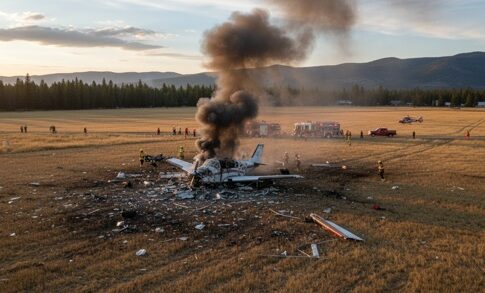
A twin‑engine 1976 Piper Aerostar crashed after takeoff near Saranac Lake, killing three people as investigators probe why the plane fell from only about 100 feet.
Story Snapshot
- Three people died when a 1976 Piper Aerostar 601P crashed after takeoff near Saranac Lake.
- The plane lost contact around 100 feet in the air and burst into flames in nearby woods.
- Federal investigators are examining the wreckage; the cause is not yet known.
- The crash is the second deadly Adirondack plane accident in two days, raising safety questions.
Deadly Takeoff Near Adirondack Regional Airport
New York State Police said a small airplane went down near the Adirondack Regional Airport late Monday night. Dispatchers received word of a downed aircraft at about 11:15 p.m., near Hearf’s Way and State Route 186 in Harrietstown. A 1976 Piper Aerostar 601P had taken off shortly after 10:30 p.m. and lost contact around 100 feet in the air before crashing into a wooded area. The plane caught fire, and all three people on board died at the scene.
Federal officials from the National Transportation Safety Board and the Federal Aviation Administration opened an investigation. Crews secured the scene overnight as investigators began documenting debris, flight path, and any signs of preimpact problems. Authorities have not released a cause. That step often follows several weeks of evidence gathering, interviews, and lab work on engines and instruments. Officials said more details will come in a preliminary report once early facts are verified.
What Investigators Will Look For
Investigators will map the wreckage to learn if the aircraft had power and control before impact. They will examine the propellers, fuel system, and flight controls. They will also check pilot records, weather, maintenance logs, and air traffic data. In a recent upstate case, investigators found no engine failure in a separate twin‑engine crash, showing how early guesses can be wrong. That is why officials avoid naming a cause too soon.
The model involved, an Aerostar 601P, is a high‑performance, pressurized twin. Past Aerostar accidents have involved many different factors, from weather to pilot workload. A historic database entry notes a 1979 Aerostar crash after an engine issue, but those details do not set a rule for today’s case. Each crash turns on its own facts, and even similar aircraft can fail for very different reasons. The current inquiry will hinge on physical proof from this wreck.
A Community On Edge After Two Fatal Crashes
Local residents in the Adirondacks are on edge. Reporters noted this was the second deadly crash in the region in two days. That kind of cluster sharpens public fear, even when the events are unrelated. Safety experts caution that quick links between crashes can mislead people. Still, the strain on small airports, first responders, and families is real when tragedies land so close together.
Dr. Gabriele Jasper, family, dead after plane crash in upstate New York https://t.co/8lH3BA9N8Z
— Asbury Park Press (@AsburyParkPress) July 16, 2026
People across the political spectrum share the same core demand here: tell the truth fast and fix what is broken. Many feel that government agencies answer slowly and talk in circles. When a plane falls from the sky right after takeoff, it shakes faith in basic safeguards. Clear updates from federal investigators, backed by data and released on time, can help rebuild trust. Facts, not spin, should guide any next steps in training, maintenance, or oversight.
Why Early Reports Can Get Details Wrong
Early news after a crash often includes painful personal details. Officials typically wait to confirm identities and family ties until medical examiners complete their work. That process protects families and avoids mistakes. Media summaries and social posts can spread unconfirmed claims before that happens. Readers should watch for official releases from state police and federal investigators, which are designed to correct the record as facts harden.
What Comes Next
In the next few days, the National Transportation Safety Board will likely issue a short preliminary report with basic facts. That document often lists the time, place, aircraft, pilot certificate, and visible damage. Months later, a final report may explain the probable cause and any contributing factors. If the cause points to training, equipment, or oversight gaps, local airports and federal agencies can update rules to reduce repeat risks.
Sources:
nypost.com, newyorkupstate.com, baaa-acro.com, data.ntsb.gov, faa.gov, youtube.com