
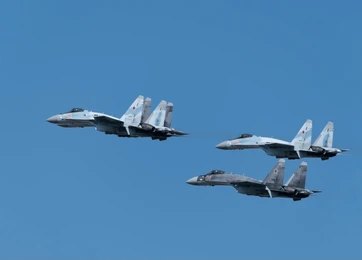
A reported 118-mile Russian missile strike on a Ukrainian fighter has highlighted the difficulty of independently verifying battlefield claims during the war.
Story Snapshot
- Ukraine confirms a lost MiG-29 and a surviving pilot, but not a record-long missile kill.
- Russian media hails a 190 km strike from inside Russia using the long-range R-37M missile.
- Key details — location, number of jets hit, and engagement type — do not match on both sides.
- Independent verification is missing, leaving citizens to sort fact from spin in a foggy information war.
What Ukraine and Russia Each Say Happened
Ukrainian Air Force officials say they lost a MiG-29 fighter jet during a combat mission in the Poltava region on June 27, 2026, and that the pilot ejected and survived. They also state that the exact cause of the loss is still under investigation and do not confirm that the jet was shot down by another aircraft. Russian state-linked outlets, by contrast, push a dramatic story: a Su-35S fighter, firing from inside Russian airspace, destroyed a Ukrainian MiG-29 at a distance of about 190 kilometers, or 118 miles, using an R-37M missile.
Russian media even released video they say shows two Ukrainian MiG-29 jets destroyed on the ground in the Mykolaiv region on June 28, 2026. In the same time frame, the Russian Ministry of Defense reported that its forces destroyed two Ukrainian MiG-29 jets at an airfield. However, the Russian ministry has not officially confirmed the specific 190 kilometer air-to-air kill, even as commentators praise it as proof of Russian long-range air combat power. That silence matters because it keeps this high-profile claim in a gray zone rather than in the record of verified combat events.
The Missile Behind the Headline: R-37M’s Real Capabilities
The weapon at the center of the story, Russia’s R-37M missile, is real and powerful. Open technical sources describe it as a long-range air-to-air missile with an operational range of roughly 300 to 400 kilometers, or about 186 to 249 miles, and speeds above Mach 6. It is designed to hit large support aircraft such as tankers and airborne warning planes from far away, keeping the launch fighter out of danger. The missile is compatible with the Su-35S fighter, among other Russian jets, and is already seen as a main threat to Ukrainian aircraft since late 2022.
Other defense references say the missile’s effective range depends heavily on how it is fired. A direct, non-lofted shot is described as having a range closer to 150 kilometers, with the longest ranges above 300 kilometers only possible under ideal launch conditions. These details matter because they show that a 190 kilometer engagement is technically possible but not routine. It would require the right speed, altitude, and flight profile, and usually would be aimed at a large, less agile target, not a maneuvering fighter. That tension between real capability and claimed use is part of why analysts push for hard data instead of big headlines.
Where the Story Breaks Down: Gaps, Mismatches, and Missing Proof
When you line up the claims, the story stops being simple. Ukraine says the loss happened in Poltava, a different region than Mykolaiv, which Russian media names in its videos. Russian footage appears to show only one aircraft being hit, even though its Ministry of Defense statement claims two MiG-29s were destroyed. The lack of matching locations and numbers suggests that at least part of the Russian narrative is either mistaken, mixed with another incident, or shaped for effect rather than accuracy.
So far, no independent satellite imagery, radar logs, or open-source intelligence analysis has publicly confirmed a 190 kilometer air-to-air missile path against the Ukrainian jet. The Ukrainian side has not released radar data or mission logs that would confirm or deny an air-to-air engagement, only saying the cause is under review. Analysts point out that in recent wars, especially in the Ukraine conflict, claims of extreme-range missile kills rarely get firm confirmation; a large study of air-to-air combat history found that very long-range kills are often reported but seldom backed by full telemetry or third-party radar evidence. That pattern should make citizens cautious with any “record-breaking” war story without solid proof.
Why This Matters to Ordinary Americans Watching From Afar
For Americans who already feel the government hides the truth and lets elites control the narrative, this kind of foggy war story hits a nerve. People see Russian outlets bragging, Ukrainian outlets pushing back, and Western media often choosing one side’s framing. At the same time, the United States government does not rush out clear data to settle the matter, even though it likely has satellite and radar coverage in the region. That gap feeds the sense that ordinary citizens are stuck guessing while insiders look the other way.
🇷🇺🇺🇦Russian Su-35 Achieves Longest-Range Fighter Shootdown on Record after Striking MiG-29 190km Away.
Following confirmation that a Ukrainian Air Force MiG-29 fighter crashed in Poltava region on June 27, multiple sources have indicated that a Russian Aerospace Forces Su-35… pic.twitter.com/iF5GDUhLA8
— Global Surveillance (@Globalsurv) June 28, 2026
There is also a deeper issue here: weapons like the R-37M are built and sold through billion-dollar deals, including reported exports to partners like India, and stories about “record kills” help justify those sales and shape future war plans. Defense industries and allied governments gain from talking up missile performance, while the real risks and limits are hard for the public to see. Whether you lean conservative or liberal, it is easy to feel that the people paying the bills and sending their kids to war get only part of the story, filtered through profit, politics, and propaganda rather than straight facts.
Sources:
19fortyfive.com, firstpost.com, youtube.com, odin.t2com.army.mil, united24media.com