
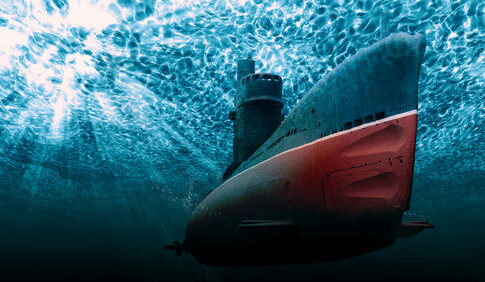
A brand-new nuclear submarine belonging to the United States Navy sank in 1969 while tied to its dock, not from enemy action or catastrophic mechanical failure, but because two separate work crews filled it with water without knowing the other team was doing the exact same thing.
When Routine Maintenance Becomes Catastrophe
The USS Guitarro represented the cutting edge of Cold War submarine technology when construction began in December 1965. As a Sturgeon-class nuclear attack submarine, she was designed for antisubmarine warfare during an era when the Navy rapidly expanded its underwater fleet. Mare Island Naval Shipyard near San Francisco Bay had successfully built nuclear submarines before, making what happened on that May evening in 1969 all the more shocking. The vessel had been launched successfully the previous July and was nearing completion, scheduled for commissioning in January 1970.
During pre-commissioning work, shipyard employees removed a bolted manhole cover and a 3.5-foot cofferdam from the bow sonar dome to replace faulty transducers. This was standard procedure, nothing unusual. What happened next violated every principle of competent shipyard management. The workers simply failed to reinstall these critical components after completing the repairs. Meanwhile, two separate teams prepared to conduct ballasting operations—one nuclear crew and one non-nuclear crew—without coordinating their activities or checking on each other’s work.
The Perfect Storm of Incompetence
At approximately 8:30 PM Pacific Daylight Time on Thursday, May 15, 1969, both teams began filling their respective sections of the submarine with water. One team conducted trimming operations while the other performed calibration tests. As water poured into the hull from two independent sources, the submarine’s bow dipped lower and lower into the water. The open manhole and missing cofferdam in the forward sonar dome—oversights that should never have occurred—became a gaping wound. Water rushed through the unsecured opening with devastating efficiency.
The submarine that was supposed to hunt Soviet vessels in the depths of the ocean instead settled ignominiously into the mud at the bottom of its own berth. No alarms sounded, no enemy torpedoes struck, no reactor melted down. The USS Guitarro simply filled with water and sank because the people responsible for building her failed to communicate with each other. The scene must have been surreal: a state-of-the-art nuclear attack submarine, representing millions of taxpayer dollars and America’s technological superiority, slowly disappearing beneath the surface while still tied to the dock.
Accountability and the Price of Failure
The Navy faced immediate embarrassment and mounting costs. Salvage operations began immediately, and crews managed to refloat the submarine by 11:18 AM on Sunday, May 18, 1969—three days after she went down. The damage assessment revealed what everyone already suspected: this disaster was entirely preventable. Representative L. Mendel Rivers chaired an Armed Services Investigating Subcommittee that probed every aspect of the incident. Their conclusion pulled no punches. The subcommittee found culpable negligence on the part of shipyard workers and highlighted catastrophic coordination failures despite the existence of detailed procedural directives.
What makes this incident particularly galling from a conservative, common-sense perspective is that proper procedures existed but were simply ignored. The shipyard maintained over 300 pages of safety protocols and construction guidelines. This wasn’t a case of inadequate planning or unforeseen circumstances. Workers had clear instructions, established chains of command, and proven systems designed specifically to prevent such disasters. The failure occurred because individuals within a hierarchical structure operated in silos, prioritizing task completion over basic safety verification. Personal responsibility and attention to detail—fundamental values in any serious enterprise—evaporated in the face of bureaucratic complacency.
Lessons Written in Saltwater and Taxpayer Money
The financial toll reached staggering proportions for what amounted to leaving a manhole cover off and failing to make a phone call. Beyond the immediate salvage costs, the Navy faced extensive repairs and a three-year delay before the Guitarro finally entered service in 1972. That represents three years of lost capability during the height of the Cold War, when every submarine counted in the strategic balance against the Soviet Union. The money could have funded other defense priorities; the time could never be recovered.
Despite this inauspicious start, the USS Guitarro went on to serve a full career until decommissioning in 1992 without further incident. The submarine worked exactly as designed once competent crews took over from negligent shipyard workers. The reactor never posed any danger—it wasn’t operational during the sinking—and no radiation was released. The vessel proved seaworthy and capable, which only underscores how unnecessary the entire debacle was. Good equipment in the hands of careless people produced a failure that better supervision and basic communication would have prevented entirely.
Sources:
Uncovered Hatches Caused a New U.S. Navy Nuclear Attack Submarine to Sink at Dock – 19FortyFive
Manhole Open: How a New US Navy Nuclear Submarine Sank While Docked – National Interest
We Left a Manhole Open: How a New Navy Nuclear Submarine Sank While Docked – 19FortyFive
The Day a U.S. Nuclear Submarine Sank at the Dock – National Security Journal
Proud