
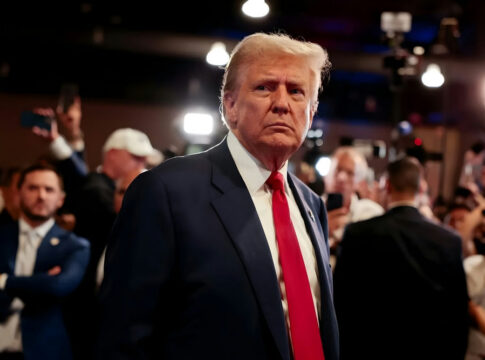
As Donald Trump waves a signed Iran “peace memo” from inside Versailles, the fine print shows a fragile, temporary bargain that could still collapse and drag Americans back toward a wider war.
Story Snapshot
- Trump says he signed an initial peace agreement with Iran at Versailles to end the war and reopen the Strait of Hormuz.
- The document is a short-term memorandum of understanding, not a full peace treaty, and lasts only 60 days before a final deal is due.
- Key issues like Iran’s nuclear program, sanctions, and long‑term control of the Strait are pushed to later talks, with either side free to walk away.
- Conflicting U.S. and Iranian statements and secretive terms fuel fears on left and right that elites cut a backroom deal while ordinary people pay the price.
What Trump Actually Signed At Versailles
Donald Trump told reporters he had formally signed an “initial peace agreement” with Tehran during a visit to France’s Versailles palace, calling it a historic step that avoided an “economic catastrophe” for the world.[3] U.S. officials say the document is a 14‑point memorandum of understanding, or MOU, meant to halt the Iran war, reopen the Strait of Hormuz, and launch a reconstruction fund of about $300 billion for Iran.[1][3] French President Emmanuel Macron and Secretary of State Marco Rubio reportedly watched the ceremonial signing.[3]
Behind the dramatic setting, the deal looks narrower and weaker than the speeches suggest. According to U.S. briefings, the signed MOU locks in only a 60‑day period of toll‑free passage through the Strait of Hormuz and a new minimum standard for diluting Iran’s highly enriched uranium.[1] In exchange, Washington promises to waive, but not fully end, some sanctions once the memorandum takes effect.[1] Officials admit either side can still walk away before a fuller, final agreement is reached over the next two months.[1]
What The Memo Does — And What It Leaves Out
Reporting from U.S. and European outlets paints this as a ceasefire framework, not a permanent peace.[2][22][23] The memorandum is described as a short, 14‑point plan that freezes current fighting in Iran and Lebanon, begins reopening shipping, and outlines future talks on nuclear issues and sanctions relief.[22] Analysts say it will likely reduce violence and boost oil flows in the short term but does not settle who truly controls the Strait of Hormuz, nor the long‑term limits on Iran’s nuclear program.[22][23]
Draft terms shared with journalists suggest the United States wants Iran to stop enriching uranium for 15 to 20 years, dismantle key nuclear sites, and allow enriched material to be destroyed and removed from the country.[14][16] In return, Iran would see sanctions eased, frozen assets gradually released, and major reconstruction money over time.[5][16][21] But Iranian sources stress that Tehran keeps “management” of the Strait and will only normalize transit after the war ends and U.S. and Israeli threats to shipping stop, rejecting any idea of “free passage” on Western terms.[1][16]
Confusion, Denials, And The 60‑Day Clock
For weeks leading up to Versailles, the two governments sent mixed and often clashing messages about whether a deal even existed. Trump repeatedly claimed a settlement was “largely negotiated,” “all signed,” or already “approved” by Iranian leaders, even as Tehran’s state media said “nothing has been finalized” and called some reported texts fabricated or an “American wish list.”[11][14][17][19] At times, the White House dismissed Iranian leaks as false while Iranian outlets denied U.S. talking points about nuclear and Strait concessions.[1][17]
Even U.S. officials now frame the signed MOU as a starting signal, not a finish line. One American source described the signed text as final in wording but only backed by a “gentleman’s agreement” to seek a lasting pact within 60 days of talks.[1] If those talks fail, the memorandum allows both sides to walk away, and previous U.S. briefings have openly tied framework proposals to the threat that military strikes and the blockade could resume.[5][15] That means the Versailles signing may pause the crisis, but it does not remove the gun from the table.
Why Both Left And Right See A Rigged Game
The structure of this deal feeds a deeper anger many Americans already feel toward Washington’s ruling class. Ordinary people hear that a secretive memo, drafted with foreign mediators, can move hundreds of billions of dollars, reshape oil markets, and send or spare U.S. troops, yet they cannot see the full text or have any real say.[1][3][16][22] Conservatives wary of endless wars and globalist entanglements see another open‑ended security commitment tied to costly reconstruction and complex international promises.
==> IRAN / USA MOU.. let me cut through all noise from Dems and some Repubs.
What the MOU Actually Is:
It's a preliminary/interim framework (often called the "Islamabad Memorandum of Understanding" in reports), not a final peace treaty. It was agreed in recent days (around…
— FredH (@FredH63966) June 18, 2026
Liberals worried about human rights and inequality see powerful governments cutting bargains with an authoritarian regime while refugees, soldiers, and working families bear the costs of war and sanctions.[16][22] Across the spectrum, many now suspect a recurring pattern: big announcements of “historic” deals, fast market reactions, and then later walk‑backs or disputes over what was really agreed.[19][20][22] This Iran memo fits that pattern, raising a basic question that unites left and right: if a 60‑day, easily reversible memo is all Washington can deliver after months of war, who is this foreign policy really serving — citizens, or the same small circle of political and economic elites?
Sources:
[1] Web – Iran-US war latest: Trump says he signed initial peace agreement with …
[2] Web – Iran-U.S. negotiators have agreed to broad principles of agreement, …
[3] Web – Iran-U.S. negotiators have agreed to broad principles of …
[5] Web – Trump will ‘bomb the hell out of’ Iran if no deal reached — as it …
[11] Web – Trump says a deal with Iran and opening of Strait of Hormuz are …
[14] Web – Trump says “settlement” reached on Iran, signing could be …
[15] Web – Trump recently edited possible U.S.-Iran agreement, including on …
[16] Web – US military says it downed Iranian attack drones – as it happened
[17] Web – US, Iran issue conflicting reports on deal as Trump says no sanction …
[20] Web – The U.S. and Iran signed a preliminary peace deal, but the terms of …
[21] YouTube – WAR IS OVER! US-Iran Peace Deal Explained In Detail
[22] Web – Experts react: The US and Iran just announced an interim peace …
[23] Web – Initial US-Iran deal ‘should not be overestimated’ – DW.com